





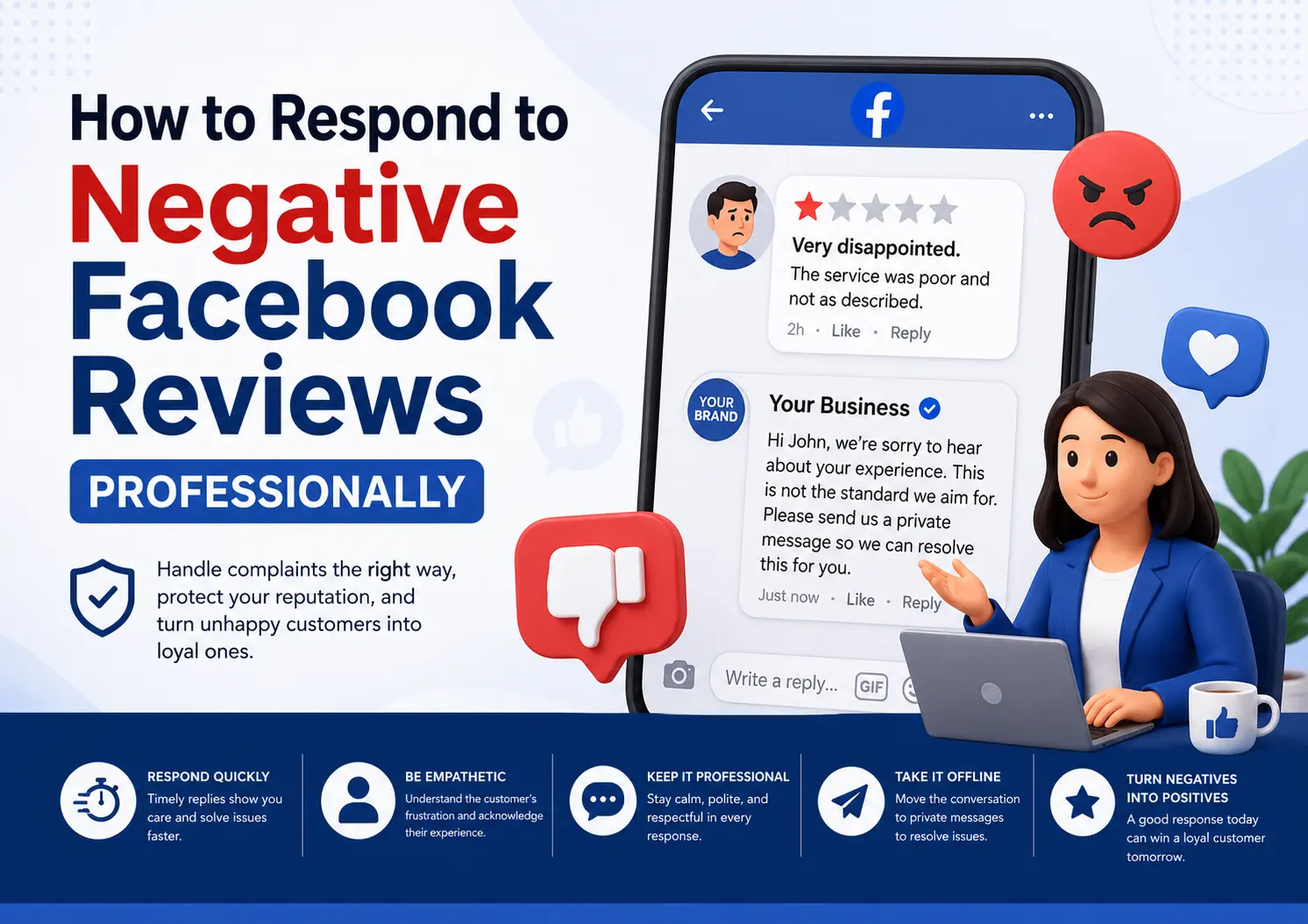
Getting a negative Facebook review can be frustrating.
You open your business page, see a one-star rating, and immediately want to defend yourself. Maybe the customer has misunderstood the situation. Maybe your team genuinely made a mistake. Or perhaps the person leaving the review was never even a customer.
Whatever the reason, your response matters.
I have noticed that people often pay almost as much attention to a business owner's response as they do to the original complaint. A negative review does not always damage trust. A rude, defensive, or careless response can.
The good news is that negative feedback can sometimes become an opportunity to show how your business treats people when something goes wrong. Here is how to handle these reviews professionally without sounding like a robot.
Why Your Response to a Negative Facebook Review Matters
When you reply to a Facebook review, you are not only speaking to the person who wrote it.
Future customers may read the conversation too.
Imagine someone visits your Facebook page and finds a customer complaining about a delayed order. Underneath, the business replies:
“Not our fault. You gave us the wrong information.”
Even if the business is technically correct, the response feels aggressive.
Now compare it with:
“Hi Sarah, we're sorry your order was delayed. We checked the details and found that there was an issue with the delivery information provided. We'd still like to help you resolve this, so please send us a private message with your order number.”
Same situation. Very different impression.
The second response shows control, professionalism, and a willingness to help.
Respond Quickly, but Do Not Reply While Angry
Fast responses are usually good, but an immediate emotional response is not.
If a review annoys you, give yourself enough time to read it properly before replying. I have seen business owners turn a small complaint into a much bigger public argument simply because they responded while frustrated.
Read the review twice.
Ask yourself a few questions. What exactly is the customer unhappy about? Is the complaint genuine? Can you solve the problem? Is there missing information?
Then write your response.
You do not need to wait several days. In most cases, replying within 24 hours is reasonable. The goal is to be responsive without being reactive.
Start by Acknowledging the Customer's Experience
One common mistake I see is businesses immediately trying to prove the customer wrong.
That rarely looks good.
Acknowledging someone's experience does not necessarily mean admitting that every claim they made is correct. You can recognise their frustration without accepting blame for something your business did not do.
For example:
“Hi James, we're sorry to hear that you were disappointed with your experience.”
That is simple. Human. Professional.
Compare it with:
“You are wrong. Our records show that we did everything correctly.”
Even if your records are accurate, the second response immediately creates conflict.
People want to feel heard before they are given an explanation.
Personalise Your Response
Copy-and-paste replies are easy to spot.
If every negative review receives the same response — “We apologise for the inconvenience. Please contact our support team” — people may assume that the business does not genuinely care.
Use the customer's name when appropriate. Mention the actual issue. Keep the reply relevant.
Generic response
“We are sorry for your experience. Please contact us.”
Better response
“Hi Emma, we're sorry to hear that your delivery arrived later than expected. We understand how frustrating that can be, especially when you were expecting it before the weekend. Please send us your order number privately so we can check what happened.”
The second response takes a little longer to write, but it feels real.
From my experience, small details make a big difference. You do not need to write a long paragraph. You just need to show that you actually read the review.
Apologise When Your Business Made a Mistake
Businesses make mistakes.
Orders get delayed. Messages are missed. Staff members have bad days. Systems fail.
If your business genuinely made an error, a clear apology is usually better than making excuses.
You could say:
“Hi Daniel, you're right that we should have responded sooner. We missed your message, and we apologise for that. We've now reviewed what happened and are working to make sure similar enquiries are handled more quickly.”
That response does not make the business look weak. It makes the business look responsible.
One thing that surprised me when observing customer reviews is how often an honest apology can calm a situation. Some customers even update their reviews after a problem is resolved properly.
Do not promise something you cannot deliver, though. A fake apology followed by no action can make the situation worse.
Explain the Situation Without Becoming Defensive
Sometimes the customer does not have the full story.
Perhaps a delivery delay was caused by an incorrect address. Maybe a refund was already processed but had not yet appeared in the customer's bank account. You can explain this, but your tone matters.
Avoid language that sounds like you are blaming the customer.
Instead of:
“You entered the wrong address, so the delay is your fault.”
Try:
“We checked the order and found that the original delivery details may have caused a delay. We'd be happy to review this with you privately and see what we can do to help.”
You are still explaining the issue. You are just doing it without starting a public fight.
Move Complicated Conversations to Private Messages
Not every complaint should be handled completely in public.
If you need an order number, email address, phone number, payment information, or other private details, ask the customer to continue the conversation through a private message or your official support channel.
A public response might say:
“Hi Alex, we're sorry to hear about the issue with your order. We'd like to investigate this properly. Please send us a private message with your order number, and our team will check the details.”
This shows other readers that you are taking action while protecting the customer's personal information.
Do not ask people to post sensitive information publicly.
What If the Facebook Review Is Fake?
Fake or misleading reviews are more difficult.
Maybe you cannot find the person's name in your customer records. Perhaps the review promotes a competitor. In some cases, the review may contain spam, harassment, or completely unrelated content.
Do not immediately accuse the reviewer of lying.
A professional public response could be:
“Hi, we have checked our records but have been unable to identify an order or customer interaction matching the details in this review. Please send us a private message with your order information so we can investigate further.”
This is a useful approach because it shows future readers that you tried to verify the complaint.
If the review violates Facebook's policies, you can also report it through the platform's available reporting options. However, do not assume that Facebook will remove every review simply because it is negative.
Can Positive Reviews Help Balance Negative Feedback?
Yes, but the approach should be ethical.
A business with many genuine customer experiences will naturally have a more balanced reputation than a page with only a handful of reviews. Asking satisfied customers to share honest feedback can help potential buyers understand the wider picture.
Some businesses also search online for services using terms such as buy Facebook reviews because they want to improve their page's appearance quickly. This approach needs caution. Reviews should reflect genuine customer experiences and comply with platform rules and applicable consumer-protection requirements. Misleading or fabricated reviews can damage trust rather than build it.
A better long-term approach is to make review requests part of your normal customer journey. After a successful order, completed service, or positive support conversation, politely ask the customer if they would like to share their experience.
Real feedback is more valuable because it often includes natural details that future customers actually find useful.
Common Mistakes
Arguing with the customer
A public argument rarely ends well. Even if you believe you are completely right, other people may only see a business attacking a customer.
Using the same reply for everyone
Templates can save time, but every response should be adjusted to the actual complaint.
Ignoring negative reviews
Silence can make it appear that the business does not care. You do not need to answer every comment instantly, but genuine complaints deserve attention.
Writing an extremely long defence
A five-paragraph explanation often looks worse than a short, calm response. Keep the public reply focused and move complicated details to a private conversation.
Making promises you cannot keep
Do not say, “This will never happen again,” unless you can genuinely guarantee it. A better phrase is, “We're reviewing what happened and working to prevent similar issues.”
Revealing customer information
Never publish private order details, addresses, phone numbers, payment information, or confidential conversations just to prove your side of the story.
A Simple Formula for Responding
When I look at strong review responses, most follow a simple structure:
- Address the customer politely.
- Acknowledge the problem.
- Apologise when appropriate.
- Briefly explain the situation if necessary.
- Offer a clear next step.
For example:
“Hi Sophie, we're sorry to hear that your order did not arrive when expected. We understand how disappointing that must have been. We'd like to check the delivery details and see what happened. Please send us a private message with your order number, and we'll investigate this for you.”
Nothing complicated.
The response is calm, specific, and focused on solving the problem.
Should You Ask a Customer to Change Their Negative Review?
You can, but timing matters.
Do not immediately say, “Please remove your review.”
First, solve the problem.
If the customer appears satisfied after the issue has been resolved, you can politely mention that they are welcome to update their review to reflect the final outcome.
For example:
“We're glad we were able to resolve this for you. If you feel the situation has now been handled fairly, you're welcome to update your review to reflect your overall experience.”
No pressure.
Some customers will update the rating. Others will not. Either way, your professional public response remains visible to future visitors.
Frequently Asked Questions
Should I respond to every negative Facebook review?
In most cases, yes. Genuine complaints usually deserve a response. However, obvious spam, abusive content, or unrelated posts may be better reported rather than debated publicly.
How quickly should a business respond?
Try to respond within 24 hours when possible. If you need time to investigate, you can acknowledge the review first and explain that you are checking the issue.
Should I delete negative reviews?
Businesses should not try to remove criticism simply because it is uncomfortable. If a review violates Facebook's rules, you may be able to report it. Genuine criticism is usually better handled with a professional response.
What should I do if the customer is wrong?
Correct the information calmly and avoid embarrassing the customer. State the relevant facts briefly, then offer to continue the conversation privately.
Is it a good idea to buy Facebook reviews?
Businesses searching for ways to buy Facebook reviews should consider the risks carefully. Fake or misleading reviews can violate platform rules, damage customer confidence, and create legal or reputational problems. Genuine feedback from real customers is the safer and more sustainable approach.